iv. Fabric Space — Producing
The machine is the easy part.
What takes courage is the first file. We teach the machine, and you find out what you can make with it.
The next 30 days something on free booked add it to your calendar
The space
Calibrated for one piece — ready for many.
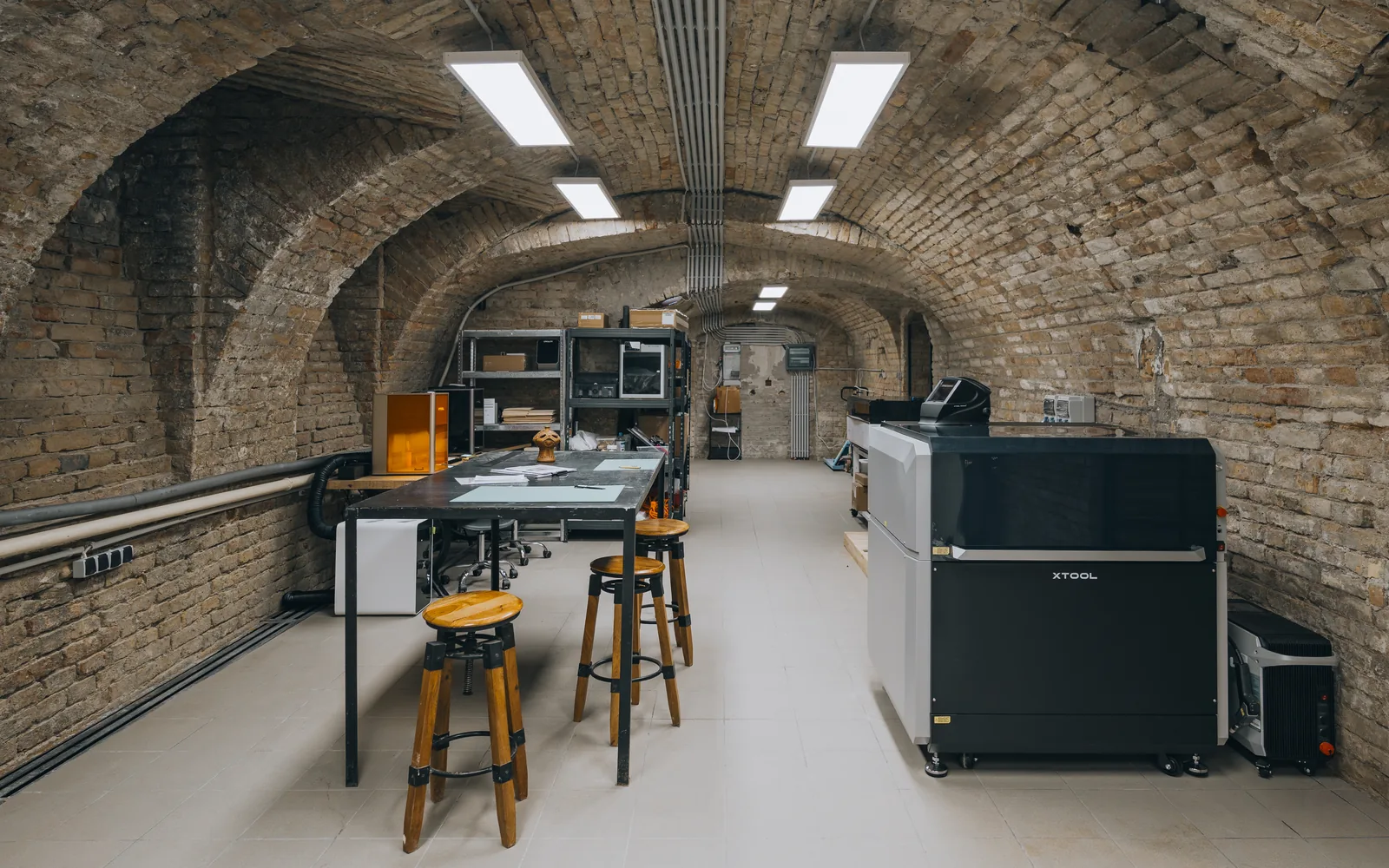
The production floor of Equora Spaces. Where prototypes become objects, where ideas earn their run — with the same restraint that shapes everything else here, applied to every piece that leaves.
The Fabric Space is direct in a way the other spaces aren't. There is a brief, a material, a deadline. The work has been thought through (in Curiosity), found its line (in Studio), been hosted (in Event). Here, it gets made.
We work across most of what a small-batch object-maker needs — cut and engraved pieces in wood, leather, paper, fabric, acrylic and metal; UV print on three-dimensional surfaces; direct-to-film textile printing; multi-material 3D printing; sheet-metal cutting, bending and finishing; assembly and packaging. This breadth, under one cellar, is unusual for a working studio of this scale — and intentional. The capability list grows. What stays constant is the standard, not the inventory.
What this is not: a print-on-demand marketplace. There is no catalogue, no upload form, no race-to-the-bottom pricing. Minimum order is one piece — but every piece is treated as if it might be the first of many.
Industrial scale is somewhere else. So is industrial indifference.
Every piece, through the same filter — PEC²: Personal · Environmentally Friendly · Creative · Collaboration.
Three ways in — and one that comes first.
Every route begins with an introduction to the machine. It is where you learn the software and the limits of the machine — without it, a file usually needs so much reworking that it is not worth it for either of us.
- i.
The introduction
A short workshop on one machine. You leave with a code that opens that machine — and only that one. Some machines we never hand over: the CNC and the sheet metal work stay with us, and you send the job in.
Where it starts · every route below.
- ii.
Send the file in
You upload the file and give us a card — we only check it, nothing is charged. We make the piece and report the actual machine time. If it would run over the agreed limit, we write first and ask before starting.
Free to cancel until we start work on it.
- iii.
Come in and work
You say how long you need, pick a slot in that machine’s calendar, and give us a card. When you have finished, we count the real time and the real material — and that is what you pay, not the estimate.
Free to cancel up to 48 hours before.
A pass is not a fourth way — it changes all three. Member rate on machine time, an allowance that covers part of it, and visits included. See the passes →
What arrives, what leaves
The Fabric Space has three doors.
Work comes in from Studio as a refined prototype, ready to be made. From B2B clients as a brief with a deadline. From Passes members with their own files and their own time.
And what leaves is the same in spirit, whatever the path in: a single object made well, or a small run with the consistency a brand can stake its name on. The path varies; the standard does not.
How it works
Whichever way you came in, it begins with the brief.
Production work moves faster than the other spaces — but the first conversation still matters more than the order form. A short note tells us what we need to know.
What it costs
Every machine, with its price.
Machine time is charged by the hour, materials on top, plus a 2,500 HUF start-up fee per machine per session — and that one is waived for pass holders. The right-hand column says what it takes to get on that machine — and what a mistake there actually costs, because that is why the introduction exists.
| Machine | Member | Without a pass | How you get on it |
|---|---|---|---|
| Laser cutting & engraving Wood, leather, paper, acrylic, textile | 3,400 HUF / hour | 4,900 HUF / hour | Introductory workshop, then on your own — approved materials only A wrong material takes the lens, the mirror and the filter with it |
| UV printing Print onto three-dimensional objects | 4,900 HUF / hour | 6,900 HUF / hour | Introductory workshop, first job accompanied A drying head is the most expensive part in the room |
| DTF textile printing Transfers for fabric, from one piece | 3,400 HUF / hour | 4,900 HUF / hour | Introductory workshop, first job accompanied Ink and film waste adds up faster than machine time |
| 3D printing, multi-material Several materials in one part | 1,900 HUF / hour | 2,900 HUF / hour | Introductory workshop, then on your own A wrong profile clogs the head and costs a day of cleaning |
| CNC milling Sheet and solid stock | 6,900 HUF / hour | 9,900 HUF / hour | Operated by us only — the rate includes the technician beside you, or send the file in The one machine where a mistake is both dangerous and expensive |
| Sheet metal Cutting, bending, finishing | 2,900 HUF / hour | 3,900 HUF / hour | Introductory workshop, then supervised period Slow to damage, quick to injure |
There is an introductory workshop for every machine, 12,900 HUF each, and it counts towards your first month if you join afterwards. Materials are billed at cost plus 15%; bring your own if you prefer, we will tell you whether the machine will take it.
When the workshop is free
Hover a day to see what is on; click it to see the free slots. Booking itself goes through the planner below — price, terms and payment included.
Price it yourself
Prefer to write? Tell us what you have in mind and we will work it out with you — the calculator is here for when you would rather not ask.
What would your session cost?
Pick the machine, say how long you need it, and choose how you come — with a pass or without one. The same session is priced both ways side by side, so the membership either pays for itself in your case or it does not, and you can see which.
In their words
What people say afterwards.
These arrive through the quest page, and we only publish the ones whose author ticked the box.
Before you worry about it
It fits the way you already work.
The most common reason people put off coming is the quiet fear that their file will be wrong, their material will be refused, or that they will need to learn something first. Here is the whole answer, in one place.
Files we take
Send what your software exports. If it opens, we will tell you whether it will cut — before anything runs.
Software you may already use
You do not have to switch. Design where you already are, bring the export, and use the machine for what the machine is for.
Your own material
Bring it. We will check it against the machine before it goes in — some materials take the lens, the filter or the room with them, and that check costs nothing. If you would rather not carry anything, ours is on the shelf and billed at what it cost us plus a margin.
If none of this is settled yet, that is what the introductory workshop is for: one evening on the machine and the software, and afterwards you can work at home too.
Already a member? Sign in to the workshop to book machine time or send in a file.
Fabric Pass
A pass changes all three ways in.
Member rate on machine time, an allowance that covers part of it each month, and visits included. The allowance comes off the machine time first, and only the rest reaches your card.
The level decides what you may book; the introductory workshop decides which machine. Cancel any month, from the next billing date — a pass transfers to another person if you ask us, qualifications do not, since those are yours.
Would you teach one?
If you know a machine or a craft well enough to hand it on, bring it here. Teaching earns machine time rather than a fee — and the room, and the audience.
Bring us one →Before you come
Questions people ask first.
Tap a question for the answer.
Do I need to know the machine already?
What is a qualification code?
Do I have to buy a pass?
How do credits work?
What if I run over my slot?
What if I do not turn up?
Can I bring my own material?
Or come and see the machines.
The prices are above, so there is nothing to ask for. If you would rather stand in front of them first, a visit takes 20–30 minutes.
Send a message
If something is happening today, a message reaches us faster than anything else.
Nothing opened — that app is probably not installed on this machine. — or just write to info@equora.space.
A question before you book is best in writing — info@equora.space. If you would rather call: +36 20 580 3000, Tuesday to Saturday, 10:00–22:00.
Every piece passes the same filter: PEC². Four words that decide before the price does — work that fails them does not happen here, however well it pays.